Wednesday, September 9, 2020

what does "vernacular" mean?


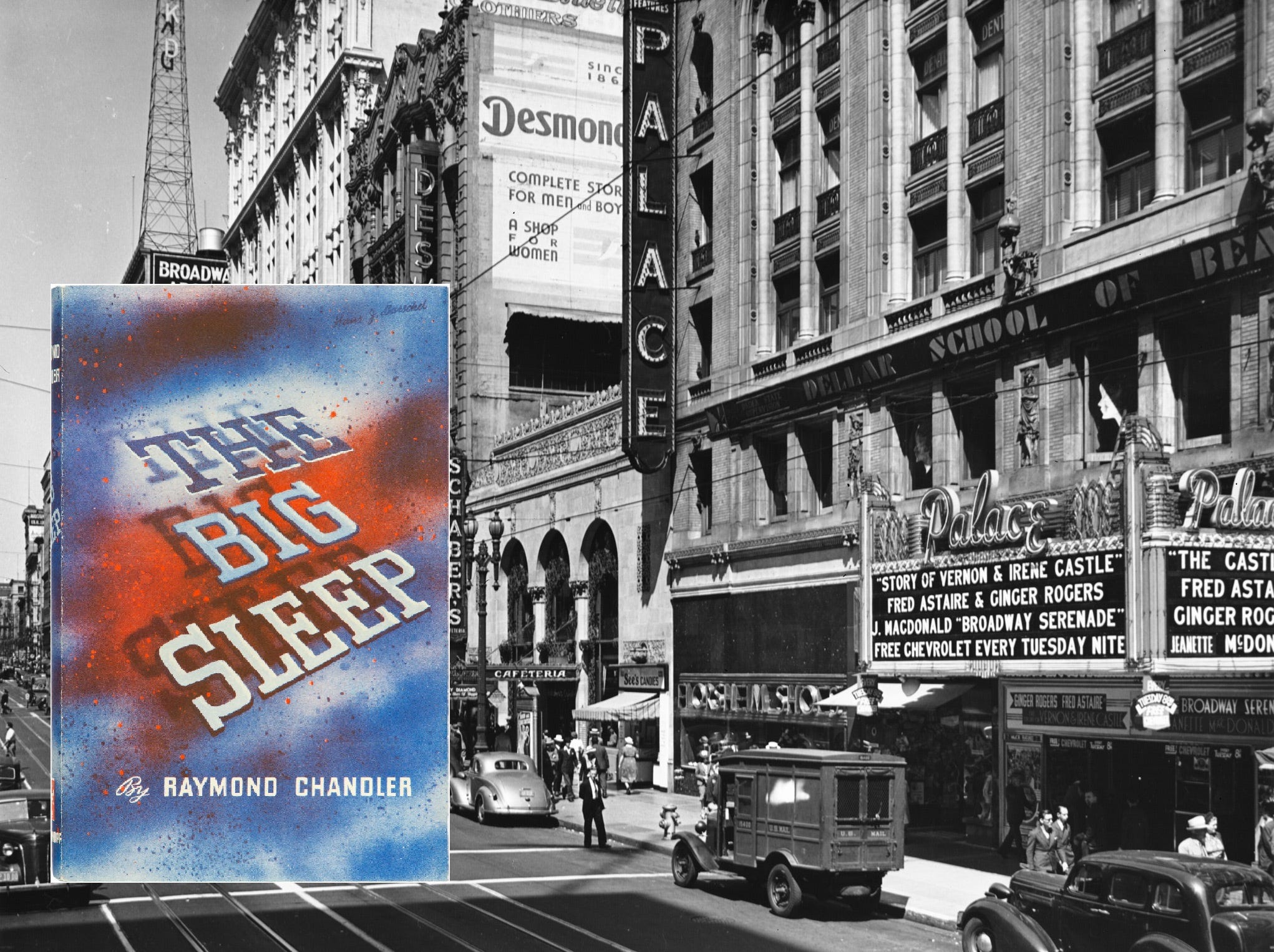
Films Media Group - Raymond Chandler's Los Angeles


2 New York Times headlines today


Rochester Police Chief Resigns After Accusations of Cover-Up in Prude Case


Dallas Police Chief Resigns in Wake of Policing Protests

_____________________________

     Ah! -- when I review Raymond Chandler's books, especially The Big Sleep, it's a transporting experience because of the unique, haunting mood he creates with his writing.

     ------------ Thunder was crackling in the foothills now and the sky above them was purple-black.  It was going to rain hard.


*       *

     ----------- The Sternwoods, having moved up the hill, could no longer smell the stale sump water or the oil, but they could still look out of their front windows and see what had made them rich.  If they wanted to.  I didn't suppose they would want to.

     Thoughts and observations and speculation are all layered in, so seamless that the reader might feel like he thought of all this himself....

---------------- She walked with a certain something I hadn't often seen in bookstores. ...

__________________________

     Reading analyses of Chandler, we come across the word "vernacular" more than once... What does it mean?


Merriam-Webster:

vernacular --

using a language or dialect native to a region or country rather than a literary, cultured, or foreign language

___________________________

     In the brief Big Sleep reading of the past week, one encounters references to material things that are flimsy and unreliable:


------------------ The rain drummed hard on the roof of the car and the burbank top began to leak.


-------------- About the only part of a California house you can't put your foot through is the front door.

____________________________________
_______________________________


-------------------------- Neither of the two people in the room paid any attention to the way I came in, although only one of them was dead.

...big houses in ghostly enormous grounds...like witch houses...


I was as wet as I could get already.  And on a night like that you can grow a beard waiting for a taxi.  And taxi drivers remember.
     Three reasons not to call for a taxi...


This stuff is all about the atmosphere, and bringing the reader -- in.  So that you're telling part of the story yourself....

----------------- I went through the house again....

Geiger wasn't in his flounced bed

or under it 

or in his closet....

That left the locked door on the right of the hall.  One of Geiger's keys fitted the lock.  The room inside was interesting, but Geiger wasn't in it.  It was interesting because it was so different from Geiger's room.
     It was a hard bare masculine bedroom....


-30-

Tuesday, September 8, 2020

a lively sense of the grotesque


Who Was the Best Philip Marlowe in the Movies? ⋆ Cladrite Radio


     The Guardian ran a series of articles on "The 100 best novels."  Number 62 was The Big Sleep.

[excerpt from the Guardian essay, written by Robert McCrum]


Enter Philip Marlowe, one of the great characters in the Anglo-American novel, a protagonist to rival and possibly surpass Sherlock Holmes.  Marlowe holds the key to the enduring appeal of this novel and the six that followed.  In 1951, Chandler told his publisher, "It begins to look as though I were tied to this fellow for life."

     Maybe he should not have been surprised.  Chandler fully understood the archetypal fictional detective, and had been polishing the character for years.  In The Simple Art of Murder (1950) he describes such a man in a famous passage:

"He must be a complete man and a common man and yet an unusual man... He is a lonely man and his pride is that you will treat him as a proud man or be very sorry you ever saw him.  He talks as the man of his age talks, that is, with rude wit, a lively sense of the grotesque, a disgust for sham, and a contempt for pettiness."


     Chandler might have been describing Philip Marlowe, who made his debut in his first novel, after several appearances in Chandler's pulp fiction stories.  He once observed of his celebrated style:  "I'm an intellectual snob who happens to have a fondness for the American vernacular, largely because I grew up on Latin and Greek."


-30-

Monday, September 7, 2020

a late dinner

Raymond Chandler's The Big Sleep and its Los Angeles, 80 Years Later | by  syfaern | Medium


--------------- [excerpt, The Big Sleep]


I unlocked the door and stepped into the still warm darkness and stood there, dripping quietly on the floor and listening to the rain.  I groped to a lamp and lit it.

     The first thing I noticed was that a couple of strips of embroidered silk were gone from the wall.  I hadn't counted them, but the spaces of brown plaster stood out naked and obvious.  I went a little farther and put another lamp on.  

I looked at the totem pole.  At its foot, beyond the margin of the Chinese rug, on the bare floor another rug had been spread.  It hadn't been there before.  Geiger's body had.  Geiger's body was gone.


     That froze me.  I pulled my lips back against my teeth and leered at the glass eye in the totem pole.  I went through the house again.  Everything was exactly as it had been.  Geiger wasn't in his flounced bed or under it or in his closet.  

He wasn't in the kitchen or the bathroom.  

That left the locked door on the right of the hall.  One of Geiger's keys fitted the lock.  The room inside was interesting, but Geiger wasn't in it.  It was interesting because it was so different from Geiger's room.  

It was a hard bare masculine bedroom with a polished wood floor, a couple of small throw rugs in an Indian design, two straight chairs, a bureau in dark grained wood with a man's toilet set and two black candles in foot-high brass candlesticks.  The bed was narrow and looked hard and had a maroon batik cover.  The room felt cold.  


I locked it up again, wiped the knob off with my handkerchief, and went back to the totem pole.  I knelt down and squinted along the nap of the rug to the front door.  I thought I could see two parallel grooves pointing that way, as though heels had dragged.  Whoever had done it had meant business.  Dead men are heavier than broken hearts.


     It wasn't the law.  They would have been there still, just about getting warmed up with their pieces of string and chalk and their cameras and dusting powders and their nickel cigars.  

They would have been very much there.  

It wasn't the killer.  He had left too fast.  He must have seen the girl.  He couldn't be sure she was too batty to see him.  He would be on his way to distant places.  I couldn't guess the answer, but it was all right with me if somebody wanted Geiger missing instead of just murdered.  

It gave me a chance to find out if I could tell it leaving Carmen Sternwood out.  I locked up again, choked my car to life and rode off home to a shower, dry clothes and a late dinner.

______________________

Raymond Chandler
publisher:  Knopf, 1939


-30-

Friday, September 4, 2020

Cleveland City Club


A Time It Was: Bobby Kennedy in the Sixties - Digital Journalist | Robert  kennedy, Kennedy, Ethel kennedy

Robert Francis Kennedy and campaigners in 1968


A brief history of political discourse in America:


1860s

"In this great struggle, this form of Government and every form of human right is endangered if our enemies succeed.  There is more involved in this contest than is realized by every one."


1930s

"We have nothing to fear but fear itself."


1960s

"Ask not what your country can do for you; ask what you can do for your country."


2020

"Nyaeh  nyaeh  nyaeh  nyaeh  nyaeh."


________________________________


------------ [excerpts] ----------- Whenever any American's life is taken by another American unnecessarily -- whether it is done in the name of the law or in the defiance of law, by one man or a gang, in cold blood or in passion, in an attack of violence or in response to violence -- whenever we tear at the fabric of life which another man has painfully and clumsily woven for himself and his children, the whole nation is degraded....


     Yet we seemingly tolerate a rising level of violence that ignores our common humanity and our claims to civilization alike.  We calmly accept newspaper reports of civilian slaughter in far off lands.  


We glorify killing on movie and television screens and call it entertainment.  We make it easy for men of all shades of sanity to acquire weapons and ammunition they desire.


     Too often we honor swagger and bluster and the wielders of force; too often we excuse those who are willing to build their own lives on the shattered dreams of others. 


Some Americans who preach nonviolence abroad fail to practice it here at home.  Some who accuse others of inciting riots have by their own conduct invited them....


------------------ [excerpts from a speech given by Robert F. Kennedy at the Cleveland City Club on April 5th, 1968]

__________________________


     On Netflix now is a film titled Bobby Kennedy For President.  It gives good information and background, and is interesting to watch and listen to.


-30-

Thursday, September 3, 2020

night scenes


DRAGON: The 100 best novel / No 62 / The Big Sleep by Raymond Chandler  (1939)

Raymond Chandler


[excerpt, The Big Sleep]

"I'm leaving it in your hands."

"Very good, sir.  May I call you a cab?"

"Positively," I said, "not.  As a matter of fact I'm not here.  You're just seeing things."

     He smiled then.  He gave me a duck of his head and I turned and walked down the driveway and out of the gates.


     Ten blocks of that, winding down curved rain-swept streets, under the steady drip of trees, past lighted windows in big houses in ghostly enormous grounds, vague clusters of eaves and gables and lighted windows high on the hillside, remote and inaccessible, like witch houses in a forest.  

I came out at a service station glaring with wasted light, where a bored attendant in a white cap and a dark blue windbreaker sat hunched on a stool, inside the steamed glass, reading a paper.  I started in, then kept going.  

I was as wet as I could get already.  And on a night like that you can grow a beard waiting for a taxi.  And taxi drivers remember.

_____________________________

-30-

Wednesday, September 2, 2020

oh yeah? well who serves steak when there's no place to sit?


The Long Goodbye (1973) - IMDb


Both Dashiell Hammett and Raymond Chandler wrote what was sometimes referred to as "hard-boiled" detective fiction.

Their main private detective protagonists were -- for Hammett, Sam Spade; and for Chandler, Philip Marlowe.

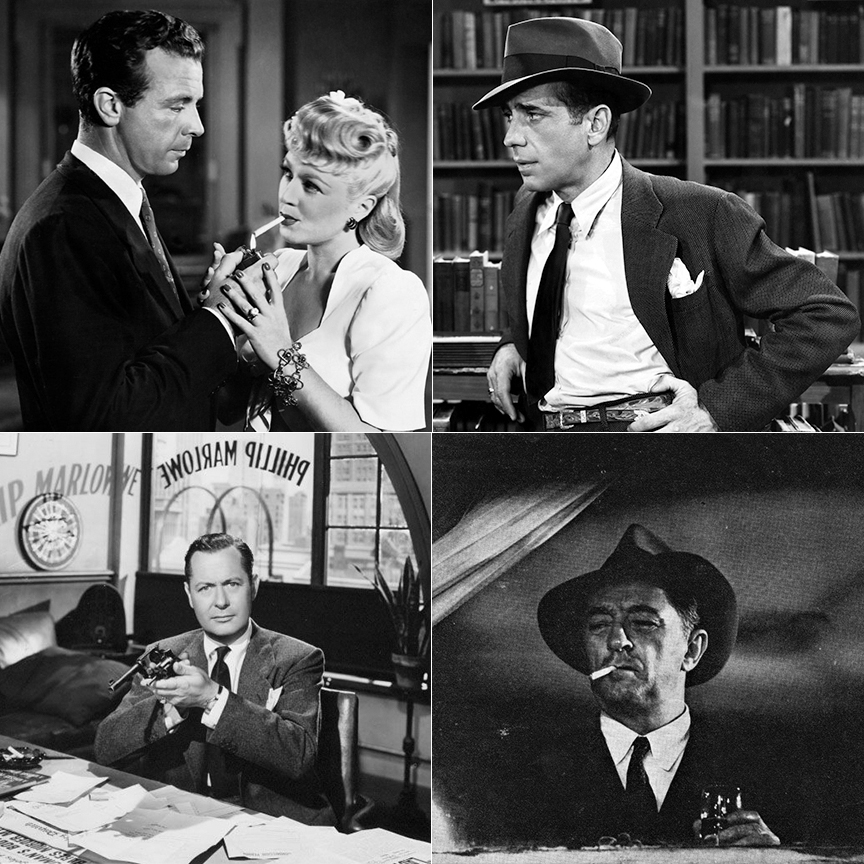
Humphrey Bogart played both -- Spade in The Maltese Falcon (1941), and Philip Marlowe in The Big Sleep (1946).

                                                 *

     Here's another tie-in between Raymond Chandler's oeuvre and the sitcom "Friends" -- actor Elliott Gould, who portrayed Monica and Ross's father Jack Geller, starred as Philip Marlowe in The Long Goodbye, a 1973 film based on Chandler's 1953 novel.


-30-

Tuesday, September 1, 2020

hitting the ground running


The Big Sleep on Apple Books


     Thinking about detective fiction writer Raymond Chandler got me remembering an episode of "Friends" where Joey and Chandler become competitive about Phoebe's choice of a baby name.  Joey wants her to name the baby Joey, and Chandler wants her to use his name.

     Joey gets all wound up and says Chandler isn't even a real name -- it's not even a word -- it's like "chandelier" but IT ISN'T!!  He challenges Chandler, "Name one other person with the name Chandler."

     Thinking fast on the spur of the moment, Chandler says in a gently triumphant tone, "Raymond Chandler!"


     Joey scoffs, "OK, somebody you didn't just make up!"


I LOLed the first time I heard that.

And the other times....

_______________________________
[excerpt from Raymond Chandler's The Big Sleep]

No more cars came up the hill.  No lights went on in the house before which I was parked.  It seemed like a nice neighborhood to have bad habits in.

     At seven-twenty a single flash of hard white light shot out of Geiger's house like a wave of summer lightning.  As the darkness folded back on it and ate it up a thin tinkling scream echoed out and lost itself among the rain-drenched trees.  I was out of the car and on my way before the echoes died.


     There was no fear in the scream.  It had a sound of half-pleasurable shock, an accent of drunkenness, an overtone of pure idiocy.  It was a nasty sound.  It made me think of men in white and barred windows and hard narrow cots with leather wrist and ankle straps fastened to them.  

The Geiger hideaway was perfectly silent again when I hit the gap in the hedge and dodged around the angle that masked the front door.  There was an iron ring in a lion's mouth for a knocker.  I reached for it, I had hold of it.  

At that exact instant, as if somebody had been waiting for the cue, three shots boomed in the house.  There was a sound that might have been a long harsh sigh.  Then a soft messy thump.  And then rapid footsteps in the house -- going away.


     The door fronted on a narrow run, like a footbridge over a gully, that filled the gap between the house wall and the edge of the bank.  There was no porch, no solid ground, no way to get around to the back.  The back entrance was at the top of a flight of wooden steps that rose from the alley-like street below.  I knew this because I heard a clatter of feet on the steps, going down.  

Then I heard the sudden roar of a starting car.  It faded swiftly into the distance.  I thought the sound was echoed by another car, but I wasn't sure.  The house in front of me was as silent as a vault.  There wasn't any hurry.  What was in there was in there.


     I straddled the fence at the side of the runway and leaned far out to the draped but unscreened French window and tried to look in at the crack where the drapes came together.  I saw lamplight on a wall and one end of a bookcase.  

I got back on the runway and took all of it and some of the hedge and gave the front door the heavy shoulder.  

This was foolish.  

About the only part of a California house you can't put your foot through is the front door.  

All it did was hurt my shoulder and make me mad.  I climbed over the railing again and kicked the French window in, used my hat for a glove and pulled out most of the lower small pane of glass.  I could now reach in and draw a bolt that fastened the window to the sill.  The rest was easy.  There was no top bolt.  The catch gave.  I climbed in and pulled the drapes off my face.


     Neither of the two people in the room paid any attention to the way I came in, although only one of them was dead.

________________________________

1939, Knopf

-30-